
Textiles at University of Leeds
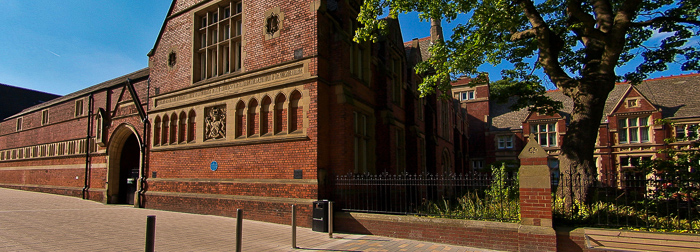
Textile teaching and research has a long and distinguished history at the University of Leeds. Since its foundation in 1874, Leeds textile graduates have made substantial contributions to industry and commerce, manufacturing and design, education and public service. The School’s research activities span fibre science and technology, yarn and fabric manufacturing including nonwovens, fabric finishing, testing and characterization and engineering of environmentally sustainable textile materials and processes for applications beyond traditional boundaries. A major research theme is textile materials for healthcare.
State-of-the-art facilities at the School of Design that are utilised by CCTMIH include:
Chemistry Synthesis and Analysis Laboratory

Provides advanced chemical and analytical resources for studying and developing materials. Supports research in dyes, coatings, and sustainable material chemistry.
The Chemistry Synthesis and Analysis Laboratory supports material creation and advanced product characterisation. From thermal transitions to colourant evaluations, the lab enables precise, application-driven insights into a wide-range of materials created.
- Accelerated Solvent Extraction- Automate extraction, filtration and clean-up of compounds from solid and semisolid samples.
- Accudry – used to simulate domestic laundering conditions and conduct drying tests and shrinkage testing.
- Capillary Electrophoresis – separation system to characterise liquid mixtures.
- Datacolour Spectrophotometer - measures, analyses, reports, shares, and visualises exact colour results.
- Differential Scanning Calorimeter (DSC)– characterisation of thermal transitions in materials during heating or cooling.
- Dimatix Materials Printer – innovative digital ink development printer.
- Fourier Transform Infrared Spectrometer (FTIR) – characterisation of organic and inorganic materials.
- Gas Chromatography Mass Spectrometer/“Nose” Analyser – characterisation of gaseous, volatiles, fragrances, and odours.
- GyroWash – measures the colour fastness of textiles and leather to washing and dry-cleaning
- High Performance Liquid Chromatography – separation system to characterise liquid mixtures.
- HPLC – MS Spectrometer – determines structural information of the separated molecules.
- Kruss Dropshape Analyser– determines contact angle and surface energy of materials.
- Micro Plate Reader– performs assays quickly and easily in both microplates or via port.
- Thermogravimetric Analysis (TGA) – determining weight changes in materials during heating.
- Thin Layer Chromatography linked to Mass Spectrometer – Obtains mass data for separated TLC plates.
- UV/Visible Spectrophotometer – with Xenon flash lamp and external xenon lamp for sample reactions in a temperature-controlled cuvette, determines fast ultraviolet/visible absorption/transmission analysis of materials.
- UV/Vis NIR Spectrophotometer - determines ultraviolet/visible absorption / transmission / reflectance of materials.
- Wascator– standard reference washing machine European retail standards.
The Materials Testing Laboratory
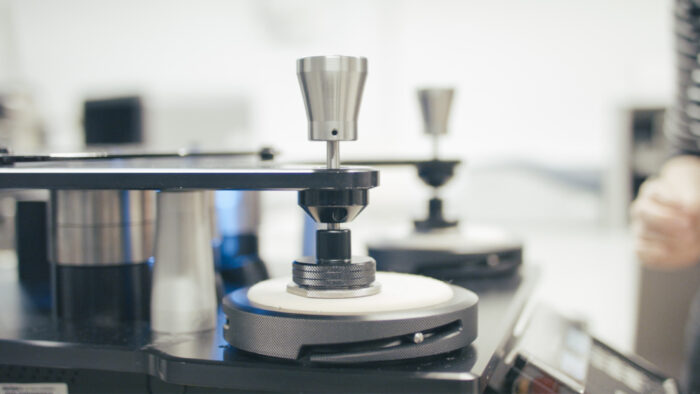
A high-tech lab for testing the physical and chemical properties of materials. Equipped with machines for tensile, thermal, and durability analysis, ensuring quality and performance compliance.
The modern Materials Testing laboratory enables the evaluation of the aesthetics, functionality, and durability of medical materials. Equipped to measure everything from abrasion resistance to moisture management, the lab ensures comprehensive material characterisation.
- Air Permeability Tester – Measures air flow through fabrics.
- Accelerator Abrasion System – Measures both dry and wet abrasion of textiles.
- Crease Recovery & Wrinkle Recovery Testers – Assess the easy-care performance of fabrics according to British and AATCC standards.
- C-Therm Thermal Conductivity Analyser – Evaluates textiles for cool/warm sensation properties.
- Crumple Flex Tester – Tests flex abrasion in coated and laminated fabrics.
- Diastron Dimensional Tester – Measures single fibre dimensions with precision.
- Diastron Tensile Tester – Analyses tensile strength of individual fibres.
- Drape Meter – Evaluates fabric drape using advanced image analysis software.
- ElmaTear Digital Tester – Measures tear resistance in textiles, nonwovens, and sheet materials.
- Fabric Assurance through Simple Testing (FAST) – Analyses key mechanical properties such as compression, bending, and extension.
- Friction/Peel Tester – Conducts friction and peel tests for textiles and packaging materials.
- Helmet Impact Resistance Tester – Assesses the impact resistance of protective helmets.
- Hydrostatic Head Tester – Measures water penetration resistance in fabrics.
- Kawabata Evaluation System (KES-F) – Provides comprehensive data on fabric bending, shear, tensile, compression, and surface properties.
- Martindale Abrasion Systems – Assess dry and wet abrasion in textiles.
- Moisture Vapour Permeability Dish Tester – Evaluates fabric water vapour permeability.
- Orbitor & SnagPod Tester – Tests pilling and snagging resistance in fabrics.
- ProMace Snagging Tester – Analyses snagging resistance of apparel and upholstery fabrics.
- Rain Room – Simulates varied rainfall conditions to test garment repellency and resistance.
- Spray Rating Tester – Measures water repellency.
- Sweating Guarded Hotplate (Skin Model) – Assesses thermal resistance and moisture vapour permeability.
- Taber Abrasion System – Tests abrasion resistance of coated materials like plastics and metals.
- Tensile Testers – Measure strength and deformation across diverse materials.
- Tog Meter – Determines thermal resistance of blankets, duvets, and similar textiles.
- TruBurst Tester – Evaluates bursting strength and fatigue resistance in textiles.
- UV Atlas Weatherometer – Simulates environmental exposure for weather testing.
- WickView – Tests fabric moisture management performance.
Nonwovens Laboratory
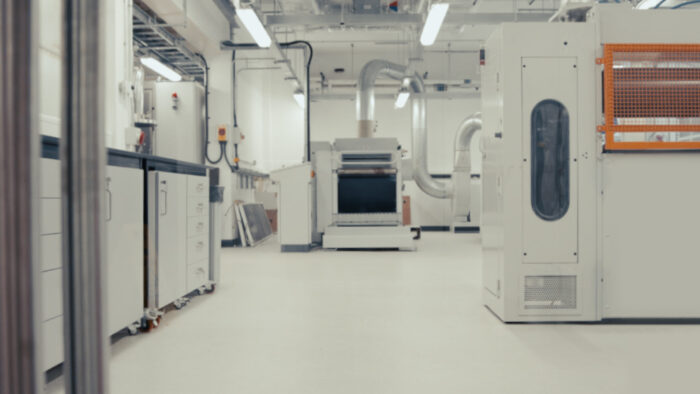
Dedicated to the study and creation of nonwoven materials. Features equipment for bonding, layering, and analysing fibers to develop versatile, high-performance textiles.
The Nonwovens Laboratory supports the scale-up development and analysis of nonwoven healthcare materials. Our advanced machinery produces micro-and nanofiber webs, high-loft insulations, and precision coatings.
- Aerospinner – Produces micro- to nanofiber webs using solution blowing or electrospinning for applications in filtration and healthcare.
- Airlaying Machine – Creates high-loft fibre webs used in insulation and interior applications.
- Biax Meltblowing Line – Produces nonwoven webs for filter media, healthcare, and insulation.
- El Marco Electrospinner – Generates nanofiber mats suitable for filtration and healthcare materials.
- Embossing Calender – Applies patterns to fabrics using heat and pressure, ideal for point bonding.
- Fiberio Centrifugal Force Spinner – Produces nanofiber webs through melt or solution spinning for filtration and absorbents.
- Krüss Force Tensiometer – Measures fibre wettability, contact angle, and surface energy.
- Laroche Cadette Shredder – Shreds textiles into fibre, promoting recycling and waste reduction.
- Melt Spinning Line – Melts and extrudes synthetic filaments for downstream manufacturing.
- Needling Line – Processes staple fibres through opening, carding, cross-lapping, and needle punching to create finished fabrics for various applications.
- Porolux 100 Porometer – Determines pore size distribution in fabrics using capillary flow porometry.
- ProGage Thickness Tester – Measures fabric thicknesses up to 5 mm, adhering to ISO 9073 standards.
- Rotary Microtome – Prepares precise sections for microscopic analysis.
- Small Carding Machine – Aligns and disentangles staple fibre to form a web for further processing.
- Small Needle Loom – Needle punches fibre webs, creating nonwoven fabrics.
- Spunbond Machine – Produces microfibre webs from melted synthetic filaments for filter media, healthcare, and construction.
- Thermobonding Oven – Uses heat and compression to bond fibre webs containing low-melt polymers.
- Ultrasonic Coater – Creates precision coatings with ultrasonic vibrations, ensuring uniform application.
Psychophysics Lab
The Psychophysics Lab provides a controlled dark environment equipped with advanced systems for precise colour measurement and visual assessments of both physical samples and digital images.
- Colour Assessment Cabinet – Provides consistent and standardised viewing environments (D65, A, F and UV) to evaluate colour variations, detect metamerism and communicate colour accurately.
- EIZO and BENQ professional-grade displays– Provides high-precision colour accuracy, consistency and performance for image reproduction.
- Verivide DigiEye System (700mm Cube) – Features a Nikon Z 6II camera for small sample analysis of textiles, food, and teeth.
- Verivide DigiEye System (1300mm Cube) – Measures colour and appearance for large sample analysis.
Wet and Dry Processing Lab
The Wet and Dry Processing Lab is designed to develop, test, and enhance textile materials through innovative processing techniques. The lab supports a wide range of research and industrial applications.
- Atmospheric Plasma Machine – Enables surface engineering of materials to impart liquid repellency, wettability, flame retardancy, lubricity, and biocompatibility.
- Capillary Rheometer – Measures the viscosity of polymeric materials.
- Electrospinning Equipment – Produces fine fibres with small diameters using electrostatic attraction between a charged polymer and a grounded target.
- FAA Micro Calorimeter – Analyses thermo-chemical parameters such as specific heat release rate, heat of combustion, and ignition temperature.
- Fibre Melt Spinner (Rondol) – Melts polymer chips and extrudes the molten polymer through a spinneret into flimanet.
- Fong Lab Jet Dyeing Machine – A small-scale jet dyer designed for low water usage in fabric dyeing.
- Gyrowash – Determines microfibre shedding from textile fabrics during aqueous processing.
- HAAKE™ MiniLab 3 Micro Compounder – Facilitates small-scale polymer compounding.
- Hydraulic Press – Compresses polymer into film or facilitates compression moulding of textile-reinforced composites.
- Laundry Facility – Features laundering machines and tumble dryers for developing innovative laundry processing techniques.
- Limiting Oxygen Index Analyser – Measures the minimum atmospheric oxygen level required to sustain burning in textile fabrics.
- Mathis Air Boy Dyeing Machine– A small-scale dyeing machine.
- Mathis Baker Steamer – A baker and steamer capable of drying, curing, and steaming for dye and chemical fixation.
- Mathis Lab Jet Dyeing Machine – A small-scale jet dyer for fabric dyeing.
- Mathis Labomat Dyeing Machine – A machine for small sample dyeing.
- Mathis Mini-Jig Dyeing Machine – A small-scale jig dyer designed for low water usage in fabric dyeing.
- Mathis Padder – A controlled applicator for wet chemicals or dyes on fabrics.
Yarn, Knit, and 2D Weave Studio

A cutting-edge facility specialising in 3D weaving technology, yarn spinning, and knitting. Equipped with state-of-the-art looms, knitting machines, and innovation tools for advanced textile production and research.
The lab-scale fibre-to-yarn conversion equipment places us at the forefront of UK yarn spinning and engineering. Its Shima Seiki knitting technologies enable the creation of sophisticated knitting structures and seamless garments.
- ARM Touch 60 Handloom – 24-shaft handlooms with integrated CAD capabilities for precise design execution.
- Laboratory Carding Machine – Processes staple fibres into webs and slivers for further manufacturing.
- Laboratory Drawing/Roving Machine – Converts carded sliver into a drawn sliver, then into roving for spinning.
- Laboratory Ring Spinning Machine – Six-spindle system capable of creating blended yarns with customisable twist parameters.
- Mageba Multi-Shuttle Weaving Machine with Staubli UNIVAL 100 Jacquard Harness – Innovative 2D-to-3D preforms seamlessly woven using state-of-the-art 3D composite weaving software from EAT.
- Optima 3D Loom – Specialised in weaving seamless tubular fabrics and other intricate structures.
- Shima Seiki Knitting Machines – Flatbed knitting machines for producing innovative, high-performance fabrics.
- Shima Seiki Mach 2S Knitting Machine – Manufactures seamless whole garments with integrated features such as pockets and buttonholes.
- TC2: Thread Controller Digital-Manual Jacquard – Hand-operated electronic weaving machine with modular harness configuration for crafting complex technical forms.
3D Weaving Innovation Lab
The 3D Weaving Innovation Lab focuses on enhancing weaving expertise, identifying new commercial opportunities for 3D woven structures in traditional and high value manufacturing sectors and producing innovative 3D woven prototype materials.
- Mageba Multi-Shuttle Weaving Machine with Staubli UNIVAL 100 Jacquard Harness – Innovative 2D-to-3D preforms seamlessly woven using state-of-the-art 3D composite weaving software from EAT.
- Optima 3D Loom – Specialised in weaving seamless tubular fabrics and other intricate structures.